Download Arduino Library For Proteus
ARDUINO
Dht11 simulation with arduino in proteus dht11 proteus library download dht11 simulation in proteus. Download the Arduino library file from the link given in the video description. Extract the file by using WinRAR software. Copy both the files and paste them into the Library folder of Proteus. Open the Proteus software and go to the “Pick devices” option to use Arduino in Proteus.
..ARDUINOGet ARDUINO SIMULATOR ..DOWNLOAD HERE
For 30 Second Delay for the above Simulator do the following steps..
1. unzip the file from virtronics and install the file as usual.
2.click on the no emails, then default email will occur
3. click on unclock .. then 230 second delay will become 30 second.
Have fun with arduino..krishna
How to add Arduino UNO Simulator (Atmega328p) to Proteus ISIS Simulator.
Proteus 8 arduino library download
Proteus 8 Installation with arduino..
OR do this..
Download ARDUINO LIBRARY FOR PROTEUS.....
Steps:- For both proteus 8 and lower version.
1.Library directory on windows 8 and 8.1 : copy this and paste on file directory.
C:Documents and SettingsAll UsersApplication DataLabcenter ElectronicsProteus 8 Professional.
2. unzip above arduino library file.
3. copy ARDUINO.IDX and ARDUINO.LIB in to library folder.
4.unzip AVR2 file.
5.copy AVR2.IDX and AVR2.LIB to library folder.
6. copy AVR2.DLL into MODELS as library location.
have a fun..krishna.
MatDuino Really interesting...SEE This Video below..
Extension package for MATdUINO. Download Arduino support from MATLAB
Raspberry PI:
Raspberry pi ..R-PI
Learn Rasberry Pi from Adafruit
The Raspberry Pi is a small computer about the size of a credit card and costs approximately £25. It was developed in the UK by the Raspberry Pi Foundation with the hope of creating a generation of children that will be inspired to learn how computers are programmed and how they function.
Download Arduino Nano Library For Proteus
Even though the Raspberry Pi is a computer, it does not have a hard drive like traditional computers do but instead, it relies on an SD card for the starting up and storing of information. In this case the SD card does the same job as a hard drive does in a traditional computer.
The SD card contains the operating system, programs and the data needed to run the Raspberry Pi. The operating system tells the Raspberry Pi how to function, how to handle any input from the user and how to manage programs when they are running. An operating system is the interface between the user and the device.
Summary of Raspberry Pi
| Developer | Raspberry Pi Foundation |
|---|---|
| Type | Single-board computer |
| Release date | 29 February 2012 |
| Introductory price | US$ 25 (model A) and US$ 35 (model B) |
| Operating system | Linux (Raspbian, Debian GNU/Linux, Fedora, and Arch Linux ARM) RISC OS |
| Power | 2.5 W (model A), 3.5 W (model B) |
| CPU | ARM1176JZF-S (ARMv6k) 700 MHz, Raspberry Pis can dynamically increase clockspeeds, and some can temporarily reach speeds up to 1 GHz. |
| Storage capacity | SD card slot (SD or SDHC card) |
| Memory | 256 MB (Model A) 512 MB (Model B rev 2) 256 MB (Model B rev 1) |
| Graphics | Broadcom VideoCore IV. |
ReferenceLanguage Libraries Comparison Changes
Libraries
The Arduino environment can be extended through the use of libraries, just like most programming platforms. Libraries provide extra functionality for use in sketches, e.g. working with hardware or manipulating data. Asce 7 10 pdf. To use a library in a sketch, select it from Sketch > Import Library.
A number of libraries come installed with the IDE, but you can also download or create your own. See these instructions for details on installing libraries. There's also a tutorial on writing your own libraries. See the API Style Guide for information on making a good Arduino-style API for your library.
Standard Libraries
- EEPROM - reading and writing to 'permanent' storage
- Ethernet - for connecting to the internet using the Arduino Ethernet Shield, Arduino Ethernet Shield 2 and Arduino Leonardo ETH
- Firmata - for communicating with applications on the computer using a standard serial protocol.
- GSM - for connecting to a GSM/GRPS network with the GSM shield.
- LiquidCrystal - for controlling liquid crystal displays (LCDs)
- SD - for reading and writing SD cards
- Servo - for controlling servo motors
- SPI - for communicating with devices using the Serial Peripheral Interface (SPI) Bus
- SoftwareSerial - for serial communication on any digital pins. Version 1.0 and later of Arduino incorporate Mikal Hart's NewSoftSerial library as SoftwareSerial.
- Stepper - for controlling stepper motors
- TFT - for drawing text , images, and shapes on the Arduino TFT screen
- WiFi - for connecting to the internet using the Arduino WiFi shield
- Wire - Two Wire Interface (TWI/I2C) for sending and receiving data over a net of devices or sensors.
The Matrix and Sprite libraries are no longer part of the core distribution.
101 Only Libraries
- CurieBLE - Interact with smartphones and tablets with Bluetooth Low Energy (BLE).
- CurieIMU - Manage the on-board accelerometer and gyro.
- CurieTimerOne - Allows to use Timer functions.
- CurieTime - Allows to control and use the internal RTC (Real Time Clock)
Due Only Libraries
- Audio - Play audio files from a SD card.
Due, Zero and MKR1000 Libraries
- USBHost - Communicate with USB peripherals like mice and keyboards.
- Scheduler - Manage multiple non-blocking tasks.
Zero and all the SAMD21 based MKR boards libraries
- AudioFrequencyMeter - Sample an audio signal and get its frequency back
- AudioZero - Play audio files from a SD card
- RTC - Real Time Clock to schedule events
- ArduinoSound - A simple way to play and analyze audio data
- I2S - To use the I2S protocol on SAMD21
WiFi 101 and MKR1000 Library
- WiFi101 - library to be used only with Wifi shield 101
- WiFi101OTA - Over-the-air updates on MKR1000
MKR WiFi 1010, MKR VIDOR 4000, Arduino NANO 33 IoT and Arduino UNO WiFi Rev.2
- WiFi NINA - library to use the WiFi Nina module of the above boards.
Arduino Nano 33 BLE, Nano 33 BLE Sense, NANO 33 IoT, Uno WiFi Rev 2, MKR WiFi 1010.
- ArduinoBLE - library to use the BLE features of the above boards.
Arduino Nano 33 IoT and UNO WiFi Rev. 2
- ArduinoLSM6DS3 - library to use the LSM6DS3 6 axis IMU available on the Arduino Nano 33 IoT and the Arduino UNO WiFi Rev. 2.
Arduino Nano 33 BLE and BLE Sense
- ArduinoLSM9DS1 - library to use the LSM9DS1 9 axis IMU available on the Arduino Nano 33 BLE and the Arduino Nano 33 BLE Sense.
Arduino Nano 33 BLE Sense
- PDM - library to use the digital microphone MP34DT05, our library PDM can be used also with our ArduinoSound library.
- ArduinoAPDS9960 - library to use the gesture sensor APDS9960; it senses gesture, color, ambience illumination and proximity.
- ArduinoLPS22HB - library to use the barometer and temperature sensor LPS22; it is an ultra-compact sensor which functions as a digital output barometer.
- ArduinoHTS221 - library to use the relative humidity sensor HTS221; it is an ultra-compact sensor that uses a polymer dielectric planar capacitor structure capable of detecting relative humidity variations, returned as digital output on a serial interface.
MKR Motor Carrier Only Library
- MKR Motor Carrier - Library to be used with the MKR Motor Carrier
MKR FOX 1200 only Library
- SigFox - library to be used only with MKRFOX1200
MKR WAN 1300 only Library
- MKRWAN - library to be used only with MKR WAN 1300
MKR GSM 1400 only Library
- MKRGSM - library to be used only with MKR GSM 1400
MKR NB 1500 only Library
- MKRNB - library to be used only with MKR NB 1500
MKR 1000, MKR WiFi 1010, MKR GSM 1400, MKR NB 1500, MKR RS485 Shield, UNO WiFI Rev.2, Ethernet Shield only Library
- Arduino Modbus - library to communicate with Modbus Protocol over RS485 and TCP with Modbus clients and servers.
MKR GPS Shield Library
- ArduinoMKRGPS - library to be used with the Arduino MKR GPS Shield
MKR RGB Shield Libraries
- ArduinoMKRRGB - library to be used with the Arduino MKR RGB Shield
- ArduinoGraphics - library with graphic primitives, works also with the MKR RGB Shield
MKR 485 Shield Libraries
- ArduinoRS485 - library that implements RS485 on the Arduino MKR RS485 shield
MKR ENV Shield Library
- ArduinoMKRENV - library to read all the values measued by the Arduino MKR ENV Shield sensors
MKR THERM Shield Library
- ArduinoMKRTHERM - library to read the sensors connected to the Arduino MKR THERM Shield
Esplora Only Library
- Esplora - this library enable you to easily access to various sensors and actuators mounted on the Esplora board.
Arduino Robot Library
- Robot - this library enables easy access to the functions of the Arduino Robot.
Yún devices Library
- Bridge Library - Enables communication between the Linux processor and the microcontroller on the Yún.
- Ciao Library - Aims to simplify interaction between microcontroller and Linino OS allowing a variety of connections with most common protocols
USB Libraries (Leonardo, Micro, Due, Zero and Esplora)
- Keyboard - Send keystrokes to an attached computer.
- Mouse - Control cursor movement on a connected computer.
Contributed Libraries
If you're using one of these libraries, you need to install it first. See these instructions for details on installation. There's also a tutorial on writing your own libraries.
Communication (networking and protocols):
- Messenger - for processing text-based messages from the computer
- NewSoftSerial - an improved version of the SoftwareSerial library
- OneWire - control devices (from Dallas Semiconductor) that use the One Wire protocol.
- PS2Keyboard - read characters from a PS2 keyboard.
- Simple Message System - send messages between Arduino and the computer
- SSerial2Mobile - send text messages or emails using a cell phone (via AT commands over software serial)
- Webduino - extensible web server library (for use with the Arduino Ethernet Shield)
- X10 - Sending X10 signals over AC power lines
- XBee - for communicating with XBees in API mode
- SerialControl - Remote control other Arduinos over a serial connection
Sensing:
- Capacitive Sensing - turn two or more pins into capacitive sensors
- Debounce - for reading noisy digital inputs (e.g. from buttons)
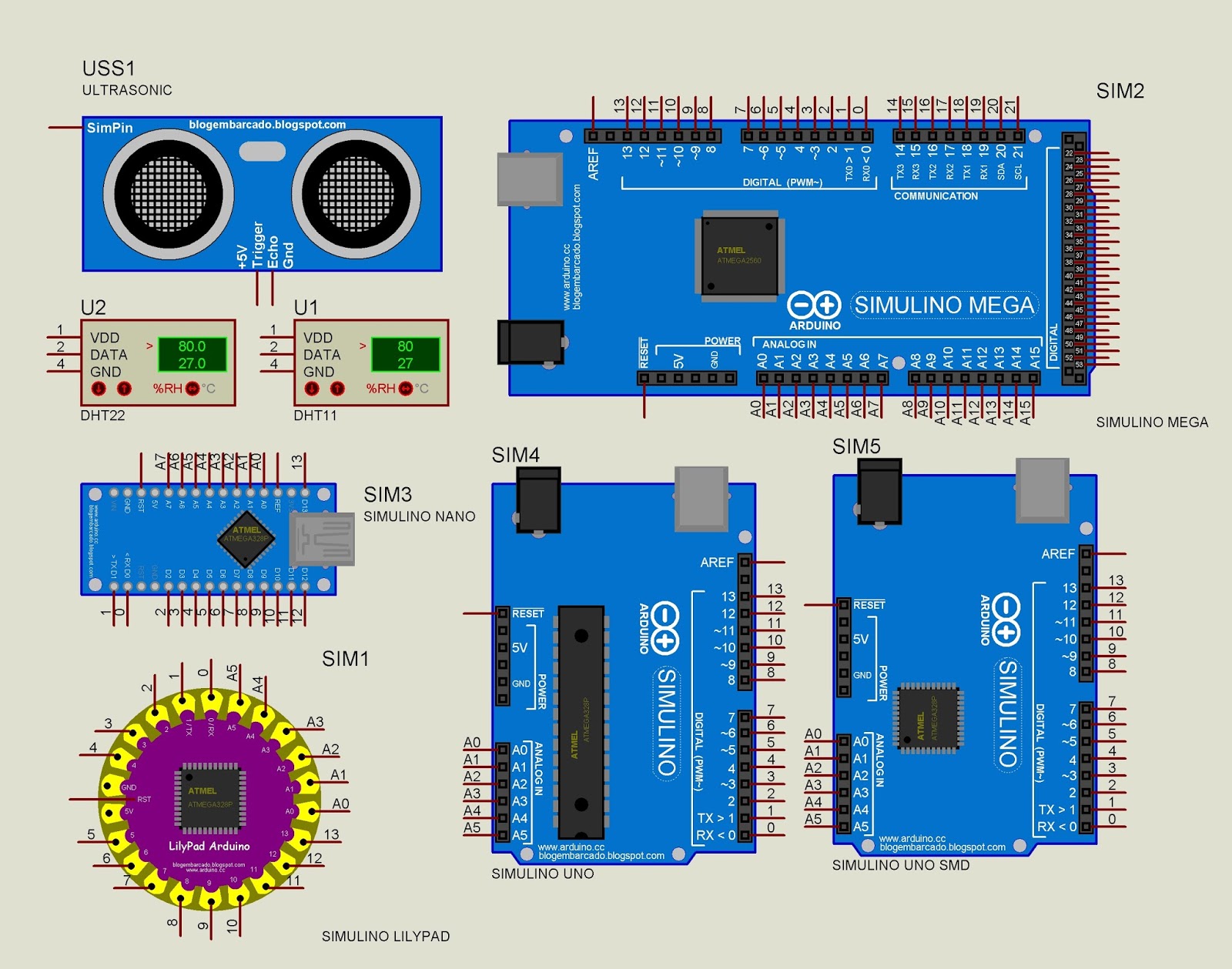
Proteus Library File
Displays and LEDs:
- GFX - base class with standard graphics routines (by Adafruit Industries)
- GLCD - graphics routines for LCD based on the KS0108 or equivalent chipset.
- Improved LCD library fixes LCD initialization bugs in official Arduino LCD library
- LedControl - for controlling LED matrices or seven-segment displays with a MAX7221 or MAX7219.
- LedControl - an alternative to the Matrix library for driving multiple LEDs with Maxim chips.
- LedDisplay - control of a HCMS-29xx scrolling LED display.
- Matrix - Basic LED Matrix display manipulation library
- PCD8544 - for the LCD controller on Nokia 55100-like displays (by Adafruit Industries)
- Sprite - Basic image sprite manipulation library for use in animations with an LED matrix
- ST7735 - for the LCD controller on a 1.8', 128x160 TFT screen (by Adafruit Industries)
Audio and Waveforms:
- FFT - frequency analysis of audio or other analog signals
- Tone - generate audio frequency square waves in the background on any microcontroller pin
Motors and PWM:
- TLC5940 - 16 channel 12 bit PWM controller.
Timing:
- DateTime - a library for keeping track of the current date and time in software.
- Metro - help you time actions at regular intervals
- MsTimer2 - uses the timer 2 interrupt to trigger an action every N milliseconds.
Utilities:
- PString - a lightweight class for printing to buffers
- Streaming - a method to simplify print statements
Reference Home
Corrections, suggestions, and new documentation should be posted to the Forum.
The text of the Arduino reference is licensed under aCreative Commons Attribution-ShareAlike 3.0 License. Code samples in the reference are released into the public domain.